 Hanashi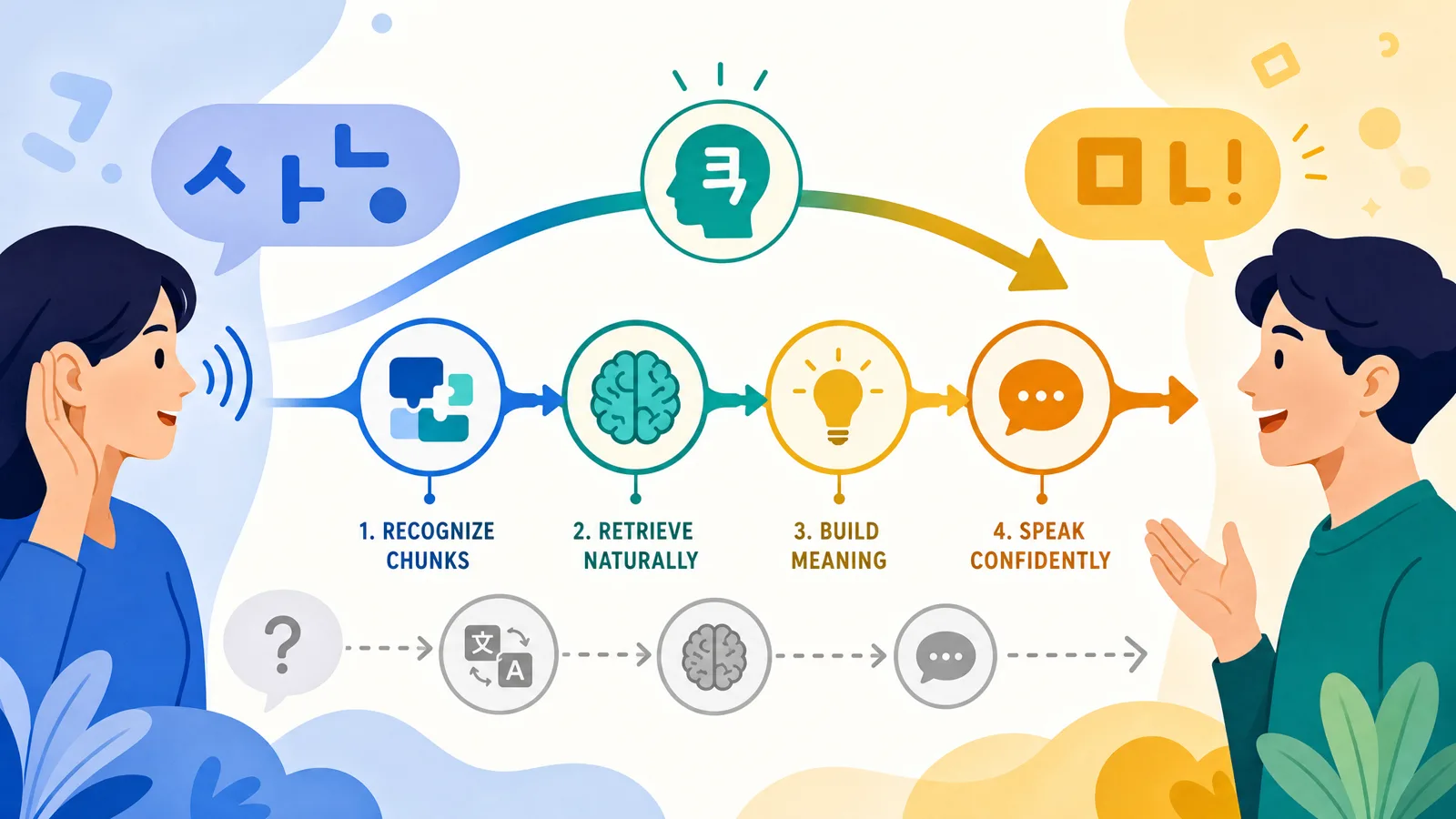
How to Think in Korean Instead of Translating
Eoin • Published May 5, 2026
How to Think in Korean Instead of Translating
If you want to know how to think in Korean, the practical answer is to stop treating every spoken sentence like an English sentence that needs to be converted. Build fast links between real situations, Korean chunks, particles, and sentence-final verbs. That means answering with phrases like 오늘은..., 카페에서..., 먹었어요, or 아직 잘 못하지만... before English has time to take over. Hanashi is useful for this because it helps you answer out loud, repeat corrected Korean, and practise realistic situations until common responses come back faster.
This guide is for Korean learners who understand more than they can say, especially if you lose time translating English word order, choosing 은/는 or 이/가, or waiting until the verb ending feels perfect.
For the wider cluster, start with the Korean speaking practice hub. If freezing is your bigger issue, read I Understand Korean but Can't Speak: What to Do. If you want a partner-free routine around these drills, pair this with How to Practice Speaking Korean Alone. If you want guided AI help, use Best AI Language Tutor for Korean Speaking Practice.
In this guide:
- Who This Is For
- What Thinking in Korean Really Means
- Why Translation Lag Feels Worse in Korean
- The Korean Chunks That Make Answers Faster
- Four Korean Drills to Reduce Translation Lag
- Examples: From English Translation to Korean-First Answers
- A Simple 7-Day Routine
- How Hanashi Fits
- FAQ
- Related Reading
Who This Is For
This article is for learners who can recognize Korean in lessons, dramas, subtitles, or podcasts, but still feel slow when they need to answer.
You are probably in the right place if:
- you build the English sentence first, then try to rearrange it into Korean
- you know the word but retrieve it too late
- you pause before choosing 은/는, 이/가, 을/를, 에, or 에서
- you reach the end of a sentence and are not sure whether to say -아요/-어요, -습니다, -고 싶어요, or -을 거예요
- you can write a clean Korean sentence with time, but cannot say it fast enough
- you avoid short conversations because the first answer takes too long
- you want practical drills, not vague advice to "immerse more"
This is not for learners who only want grammar explanations. Grammar helps, but thinking in Korean during conversation is mostly a retrieval skill: hearing a prompt, finding a usable Korean pattern, finishing the sentence, and continuing.
What Thinking in Korean Really Means
Thinking in Korean does not mean every private thought in your head becomes Korean overnight.
For speaking practice, it means something smaller and more trainable:
- you connect common situations to Korean phrases before English takes over
- you use familiar sentence frames instead of rebuilding each answer from zero
- you accept a shorter Korean answer when it is clearer and faster
- you finish the sentence with a Korean verb and ending instead of chasing the exact English wording
The useful shift is:
| Translation-heavy question | Korean-first question |
|---|---|
| How do I say this full English sentence in Korean? | What is the simplest Korean answer that fits this moment? |
| Which grammar form matches my English idea? | Which Korean chunk can start the answer? |
| How do I translate every detail? | What can I say naturally now, then add one detail after? |
That matters because spoken Korean often rewards clear, short answers. You do not need to express the full English thought immediately.
For example, if your English thought is:
I wanted to study Korean yesterday, but I got home late and felt tired.
A Korean-first answer can be:
- 어제는 한국어를 공부하고 싶었어요.
- 그런데 집에 늦게 와서 너무 피곤했어요.
That answer is not a word-by-word mirror. It is better for speaking because it gives your brain two reusable Korean pieces: 어제는... 하고 싶었어요 and 늦게 와서 피곤했어요.
Why Translation Lag Feels Worse in Korean
Translation lag is the delay between understanding a prompt and producing your answer. Korean can make that delay feel stronger because several decisions arrive at once.
| Decision | Why It Slows You Down | Example |
|---|---|---|
| Word order | English puts the verb earlier. Korean often waits until the end. | 오늘은 집에서 점심을 먹었어요. |
| Particles | Small markers carry meaning, so learners pause before nouns feel complete. | 저는, 제가, 커피를, 카페에서 |
| Sentence endings | The answer can sound unfinished or socially odd if the ending is unclear. | -요, -습니다, -고 싶어요, -을 거예요 |
| Context first | Korean often starts with time, topic, or place before the main action. | 오늘은, 주말에는, 회사에서 |
| Pronunciation pressure | Batchim and linking can make known words feel risky aloud. | 밥을 먹었어요, 집에 가요 |
The slow route looks like this:
- hear the question
- decide the English answer
- rearrange the sentence
- choose particles
- choose the ending
- search for pronunciation confidence
- speak too late
The faster route is:
- hear the question
- recall a Korean starter chunk
- finish with a familiar verb-ending pattern
- add one detail if needed
That is why the answer to translation lag is not simply "learn more words." You need chunks that already include Korean decisions.
The Korean Chunks That Make Answers Faster
To think in Korean faster, build chunks by situation. A chunk is a reusable piece of Korean that includes grammar, rhythm, and a likely place in conversation.
Start with chunks that help you begin, soften, explain, and finish.
| Function | Korean Chunks | How You Might Use Them |
|---|---|---|
| Start the answer | 오늘은..., 요즘은..., 저는..., 제 생각에는... | 오늘은 집에서 일했어요. |
| Buy time | 음..., 글쎄요, 잠깐만요, 뭐라고 해야 하지... | 글쎄요, 아직 잘 모르겠어요. |
| Give a reason | -아서/-어서, 그래서, 왜냐하면... | 비가 와서 집에 있었어요. |
| Soften uncertainty | 아직..., 조금..., 잘은 모르지만... | 아직 잘은 모르지만 재미있어요. |
| Talk about habits | 자주..., 보통..., -는 편이에요, -을 때가 많아요 | 보통 아침에 커피를 마시는 편이에요. |
| Finish cleanly | -했어요, -할 거예요, -고 싶어요, -인 것 같아요 | 주말에는 친구를 만날 거예요. |
Do not memorize these as a random phrase list. Attach each chunk to a prompt.
Prompt-based chunk bank
| Prompt | Starter Chunk | Fast Answer |
|---|---|---|
| 오늘 뭐 했어요? | 오늘은... | 오늘은 집에서 일했어요. 저녁에는 한국어를 공부할 거예요. |
| 주말에 뭐 할 거예요? | 주말에는... | 주말에는 친구를 만날 거예요. 시간이 있으면 카페에도 갈 거예요. |
| 한국어 공부는 어때요? | 아직... | 아직 어렵지만 재미있어요. 말하기가 제일 어려워요. |
| 왜 한국어를 공부해요? | 왜냐하면... | 왜냐하면 한국 드라마를 좋아하고, 한국 사람들과 이야기하고 싶어요. |
The fastest learners do not wait until they can build every answer freely. They build a reliable base, then vary one part at a time.
Four Korean Drills to Reduce Translation Lag
These drills train retrieval, not only knowledge. Say every answer out loud. If you only think the answer silently, you skip the part that needs practice.
1. Korean starter drill
Pick one prompt and force the first Korean chunk to arrive within two seconds.
Prompts:
- 오늘 뭐 했어요?
- 요즘 바빠요?
- 주말에 뭐 할 거예요?
- 한국어를 왜 공부해요?
- 뭐 먹고 싶어요?
Starter answers:
- 오늘은...
- 요즘은...
- 주말에는...
- 저는 한국어를...
- 지금은...
Rule: the starter can be simple. Your job is to block the English draft from becoming the first step.
Example:
- Prompt: 오늘 뭐 했어요?
- Starter: 오늘은...
- Full answer: 오늘은 회사에서 일했어요. 점심에는 김밥을 먹었어요.
2. Particle lock drill
Many learners lose speed because the noun arrives without a particle. Train common noun-plus-particle pairs as one unit.
Say each pair, then finish the sentence:
- 저는 -> 저는 한국어를 공부해요.
- 제가 -> 제가 먼저 말해 볼게요.
- 커피를 -> 커피를 마셨어요.
- 카페에서 -> 카페에서 친구를 만났어요.
- 학교에 -> 학교에 갈 거예요.
- 친구한테 -> 친구한테 메시지를 보냈어요.
Do not debate every particle during the drill. Use common, useful patterns. Analysis can happen after the spoken attempt.
3. Sentence-final verb drill
Korean often makes the verb and ending carry the final weight of the sentence. Practise finishing, not just starting.
Use one context and cycle the ending:
- 오늘은 집에서 일해요.
- 오늘은 집에서 일했어요.
- 오늘은 집에서 일할 거예요.
- 오늘은 집에서 일하고 싶어요.
- 오늘은 집에서 일해야 해요.
Then swap one piece:
- 오늘은 카페에서 공부했어요.
- 오늘은 도서관에서 공부할 거예요.
- 오늘은 집에서 쉬고 싶어요.
This drill teaches your brain that an answer is not complete until the Korean verb ending lands.
4. Translate less, compress more
Take one English thought and make it shorter before Korean.
English thought:
I was planning to go out, but it started raining, so I decided to stay home and study Korean instead.
Compressed Korean-first plan:
- 비가 와서
- 집에 있었어요
- 한국어를 공부했어요
Spoken answer:
- 비가 와서 집에 있었어요. 대신 한국어를 공부했어요.
The goal is not to delete meaning forever. The goal is to say a usable Korean answer now, then add detail if the conversation needs it.
Examples: From English Translation to Korean-First Answers
Use these examples as models. Notice that the Korean-first answers are not literal translations. They are shorter, more natural, and easier to retrieve.
Example 1: Talking about your day
English thought:
I had a lot of meetings today, so I could not study Korean until the evening.
Translation-heavy approach:
You try to translate "until the evening" and "a lot of meetings" at the same time, then lose the sentence ending.
Korean-first answer:
- 오늘은 회의가 많았어요.
- 그래서 저녁에 한국어를 공부했어요.
Reusable chunks:
- 오늘은...
- 회의가 많았어요
- 그래서...
Example 2: Giving an opinion
English thought:
I think Korean speaking is hard because I keep translating from English.
Korean-first answer:
- 한국어 말하기는 어려운 것 같아요.
- 영어로 먼저 생각해서 좀 느려져요.
Reusable chunks:
- -는 어려운 것 같아요
- 먼저 생각해서...
- 좀 느려져요
Example 3: Buying time politely
English thought:
Let me think. I am not sure how to explain it well in Korean yet.
Korean-first answer:
- 음, 잠깐만요.
- 아직 한국어로 잘 설명하기가 어려워요.
Reusable chunks:
- 잠깐만요
- 아직...
- -기가 어려워요
Example 4: Explaining a plan
English thought:
This weekend I might meet my friend, but I have not decided yet.
Korean-first answer:
- 이번 주말에는 친구를 만날 수도 있어요.
- 아직 결정하지 않았어요.
Reusable chunks:
- 이번 주말에는...
- -을 수도 있어요
- 아직 결정하지 않았어요
Example 5: Repairing a mistake in conversation
English thought:
Sorry, I said that wrong. I meant I studied at a cafe, not went to a cafe.
Korean-first answer:
- 아, 잘못 말했어요.
- 카페에 갔어요가 아니라, 카페에서 공부했어요.
Reusable chunks:
- 잘못 말했어요
- -가 아니라...
- 카페에서...
Repair phrases like this matter because thinking in Korean is not only about first attempts. It is also about staying in Korean after a mistake.
A Simple 7-Day Routine
Use one week to train the same small set of responses. Do not change topics every day.
| Day | Focus | What to Do |
|---|---|---|
| 1 | Build your chunk bank | Choose three prompts and write two Korean starter chunks for each. |
| 2 | Starter speed | Answer each prompt with 오늘은, 요즘은, 저는, or 주말에는 within two seconds. |
| 3 | Particles | Practise noun-plus-particle pairs: 저는, 커피를, 카페에서, 친구한테. |
| 4 | Sentence endings | Cycle one verb through present, past, future, want, and need forms. |
| 5 | Compression | Take five English thoughts and turn each into one or two Korean sentences. |
| 6 | Repair | Record one answer, fix one particle or ending, then repeat the cleaner version. |
| 7 | Conversation transfer | Use the same prompts in Hanashi, a tutor session, or a voice note and notice what arrives faster. |
Each day can take 10 to 15 minutes.
Here is a simple daily format:
- choose one familiar Korean prompt
- say one starter chunk immediately
- answer in two short sentences
- repair one particle, ending, or pronunciation issue
- repeat the same answer once more
- save one reusable chunk for tomorrow
If you want more structure after the week, use the routine in How to Practice Speaking Korean Alone and keep these translation-lag drills as the warm-up.
How Hanashi Fits
Hanashi fits when you want Korean speaking practice that turns study into spoken answers.
Use it for this specific goal:
- choose a realistic Korean situation
- answer out loud before over-planning
- get feedback on the response
- repeat the cleaner answer
- keep the same prompt long enough for retrieval to improve
For thinking in Korean, the useful part is repetition with repair. You are not just reading a better answer. You are saying the answer, noticing what slowed you down, and trying again while the context is still fresh.
A 15-minute Hanashi session for this article could look like:
| Time | Focus | Example |
|---|---|---|
| 3 min | Warm-up chunks | 오늘은..., 요즘은..., 저는... |
| 5 min | Short answers | Answer daily-life prompts in two sentences. |
| 4 min | Repair | Fix one particle, ending, or awkward translation. |
| 3 min | Repeat for speed | Say the corrected answer again without adding complexity. |
If you are still comparing tools, read Best App to Practice Speaking Korean or Best AI Language Tutor for Korean Speaking Practice.
FAQ
Can you really learn to think in Korean?
Yes, if you define it practically. The first milestone is not thinking every thought in Korean. It is responding to common situations with Korean chunks before you build a full English sentence.
Should I stop translating completely?
No. Translation can help during study, review, and vocabulary checks. The problem is relying on translation during spoken answers. In conversation, a shorter Korean-first answer is usually better than a perfect English sentence that arrives too late.
What Korean chunks should I learn first?
Start with chunks for your real conversations: 오늘은..., 요즘은..., 저는..., 아직..., -고 싶어요, -인 것 같아요, -아서/-어서, 그래서, and -을 거예요. Add particles inside chunks instead of memorizing nouns alone.
Why do particles slow me down so much?
Particles make nouns usable in Korean sentences. If you only memorize 커피, 학교, 친구, or 집, you still need to choose 커피를, 학교에, 친구랑, or 집에서 while speaking. Practise the noun and particle together.
Is it better to practise long answers or short answers?
Short answers are better at first. Two clean Korean sentences build retrieval faster than one long sentence that collapses halfway through. Add detail only after the basic response comes out smoothly.
How long does it take to reduce translation lag?
You can often notice small changes within one or two weeks if you repeat the same prompts daily. Bigger improvement comes from keeping a personal chunk bank and using those chunks in real spoken practice.
Related Reading
- If you freeze despite understanding: I Understand Korean but Can't Speak: What to Do
- If you want a daily solo routine: How to Practice Speaking Korean Alone
- If you want guided AI Korean practice: Best AI Language Tutor for Korean Speaking Practice
- If you are choosing a speaking app: Best App to Practice Speaking Korean
- If you want the topic hub: Korean speaking practice
Ready to Answer in Korean Faster?
Thinking in Korean starts when common situations connect directly to Korean chunks, particles, and sentence-final verbs. Keep the answers short, say them out loud, repair one issue, and repeat the cleaner version. To practise that loop in realistic Korean conversations, try Hanashi.