 Hanashi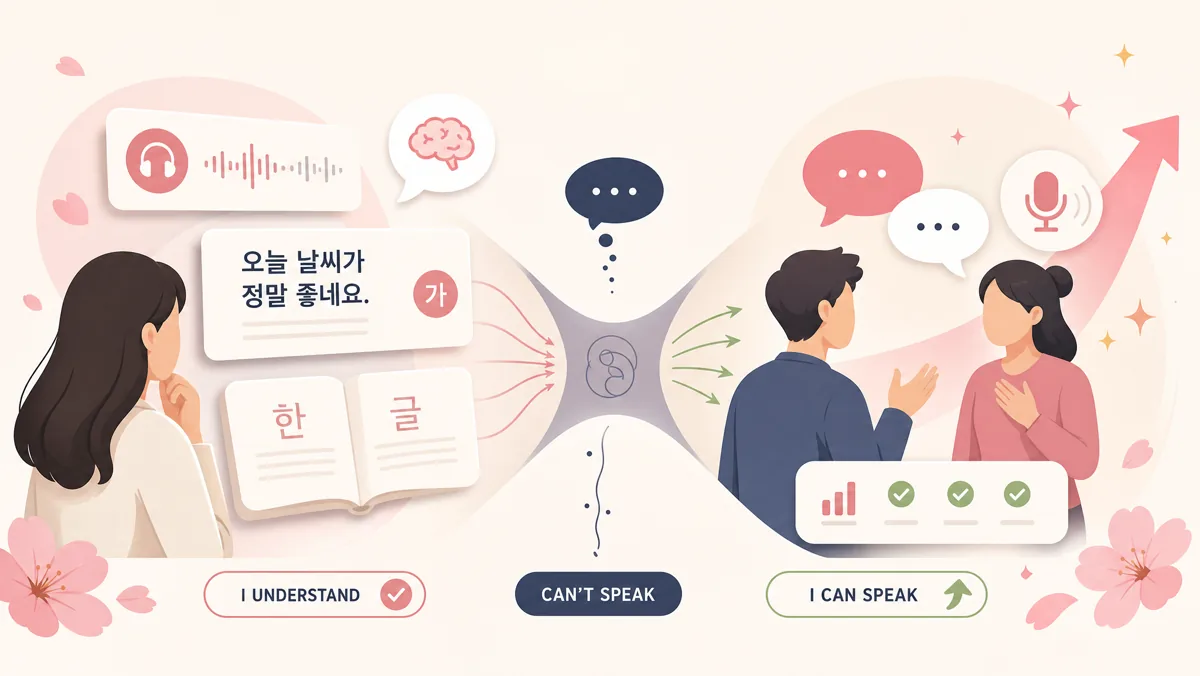
I Understand Korean but Can't Speak: What to Do
Eoin • Published May 4, 2026
I Understand Korean but Can't Speak: What to Do
If you understand Korean but can't speak it, your input is ahead of your output. You may recognize words in dramas, lessons, lyrics, or subtitles, but speaking requires faster retrieval, verb-final sentence building, particle choices, politeness endings, and pronunciation under pressure. The fix is not to restart Korean from the beginning. The fix is to train short spoken answers every day, repair one Korean-specific bottleneck at a time, and repeat the cleaner answer until it feels usable. Hanashi is a strong daily path for this because it helps you answer out loud, practise realistic Korean situations, and get feedback without waiting for a tutor or exchange partner.
This guide is for Korean learners who can understand more than they can say. It is especially useful if you freeze when someone asks 뭐 했어요?, hesitate over 은/는 or 이/가, translate from English word order, or avoid speaking because you are unsure whether your ending sounds natural.
For the wider cluster, start with the Korean speaking practice hub. If you want a partner-free routine after this diagnosis, read How to Practice Speaking Korean Alone. If you are choosing a tool for daily output, pair this with Best App to Practice Speaking Korean or Best AI Language Tutor for Korean Speaking Practice.
In this guide:
- Who This Is For
- Why This Happens
- Diagnose Your Korean Speaking Bottleneck
- What to Do Instead
- A 20-Minute Routine to Close the Gap
- Mistakes to Avoid
- How Hanashi Can Help
- FAQ
- Related Reading
Who This Is For
This article is for learners whose Korean comprehension feels real, but whose spoken answers still feel slow or fragile.
You are probably in the right place if:
- you can follow slow Korean videos, subtitles, or lessons, but cannot answer naturally
- you know many words only when someone else says them first
- you can write a sentence with time, but cannot say it out loud fast enough
- you pause over particles like 은/는, 이/가, 을/를, 에, and 에서
- you are unsure whether to use -요, -습니다, or casual endings
- you build sentences in English first, then try to flip them into Korean
- 받침, linking, and sound changes make familiar words feel risky when spoken
- you avoid live conversation because you do not want to sound rude, childish, or blank
This is not a sign that your listening or reading has been wasted. It means your practice has trained recognition more than production.
Why This Happens
Understanding Korean and speaking Korean use different skills.
When you listen or read, Korean gives you support: context, sentence endings someone else has already chosen, and enough clues to guess meaning. When you speak, those supports disappear. You have to choose the word, assemble the sentence, say the ending, and keep going before doubt interrupts you.
Korean adds several specific pressure points:
- Particles and topic markers: 저는, 제가, 커피를, 카페에서, 친구한테 all carry meaning, and the choice can slow you down.
- Politeness endings: you need a default register before your answer can leave your mouth. Many learners overthink whether to say 가요, 갑니다, or 가.
- Verb-final sentence building: Korean often saves the main action for the end, so English word order can cause a traffic jam.
- 받침 and linking: words you know on paper can feel different aloud, especially in phrases like 밥을 먹었어요, 집에 가요, and 한국어를 배워요.
- Sound-change pressure: pronunciation rules can make learners hesitate even when the sentence is grammatically simple.
- Translation delay: if your first draft is "I ate lunch at home," you still have to rebuild it as 저는 집에서 점심을 먹었어요.
That is why more input alone may not fix the problem. Listening and reading help, but speaking improves when you practise retrieval, sentence assembly, and repair out loud.
Diagnose Your Korean Speaking Bottleneck
Use this framework to find the actual gap. Do not treat every frozen moment as "I need more vocabulary."
| What Happens | Likely Bottleneck | Korean-Specific Sign | Best Fix |
|---|---|---|---|
| You know the word after the conversation ends | Retrieval speed | 학교, 약속, 주문하다, or 필요하다 appears too late | Timed short-answer practice with repeated topics |
| You stop before the verb | Verb-final sentence building | You start with English order and lose the Korean ending | Practise context + object + verb-ending patterns |
| You hesitate over 은/는 and 이/가 | Particle pressure | You know the noun but cannot attach the marker quickly | Use fixed sentence frames before freer answers |
| You sound too formal, too casual, or unfinished | Politeness and endings | You cannot choose between -요, -습니다, or casual speech | Default to polite -요 for daily practice, then vary later |
| You can write it, but your mouth trips on it | Pronunciation transfer | 받침, linking, or tense sounds make the sentence collapse | Repeat short phrase chains aloud, not isolated words |
| You translate the whole sentence first | English-order dependency | You think "I at cafe coffee drank" before speaking | Train Korean chunks: 오늘은..., 카페에서..., 마셨어요 |
A quick self-check
Answer these prompts out loud in Korean:
- 오늘 뭐 했어요?
- 주말에 뭐 할 거예요?
- 한국어를 왜 공부해요?
- 요즘 뭐가 재미있어요?
Then ask:
- Did the answer arrive late even though I knew the words?
- Did I freeze at the particle?
- Did I lose the verb ending?
- Did pronunciation make me stop?
- Did I translate from English before saying anything?
Your next practice session should target the answer to those questions, not a vague feeling that you are "bad at speaking."
What to Do Instead
The best fix is a narrow loop: answer, repair, repeat.
Do not start with long monologues. Korean speaking gets easier when you make common decisions automatic first. Use short, polite sentences that you can adapt:
- 저는 한국어를 공부하고 있어요.
- 오늘은 집에서 일했어요.
- 점심에 김밥을 먹었어요.
- 주말에는 친구를 만날 거예요.
- 아직 잘 못하지만 천천히 말해 볼게요.
Then train one bottleneck at a time.
If particles slow you down
Practise sentence frames where the particle is already part of the pattern:
- 저는 ___을/를 좋아해요.
- ___에서 공부했어요.
- ___에 갈 거예요.
- 친구한테 ___을/를 말했어요.
Say the sentence with real nouns:
- 저는 커피를 좋아해요.
- 도서관에서 공부했어요.
- 내일 학교에 갈 거예요.
- 친구한테 계획을 말했어요.
If endings slow you down
Choose polite -요 as your default. It is useful in many everyday learner situations and reduces decision-making.
Start with:
- 가요 / 갔어요 / 갈 거예요
- 먹어요 / 먹었어요 / 먹을 거예요
- 해요 / 했어요 / 할 거예요
- 좋아해요 / 좋아했어요 / 좋아할 것 같아요
You can practise -습니다 for interviews, presentations, or formal settings later. You can practise casual speech when the relationship calls for it. For most daily practice, removing the register decision helps you speak sooner.
If English word order slows you down
Build Korean from left to right with small chunks:
| Chunk | Role | Example |
|---|---|---|
| 오늘은 | Topic or time frame | Today... |
| 집에서 | Place or context | at home... |
| 점심을 | Object | lunch... |
| 먹었어요 | Verb and ending | ate. |
Say the full sentence only after the chunks are clear:
오늘은 집에서 점심을 먹었어요.
Then vary one piece:
- 오늘은 카페에서 점심을 먹었어요.
- 어제는 집에서 저녁을 먹었어요.
- 오늘은 친구랑 점심을 먹었어요.
If pronunciation makes you freeze
Practise phrase chains instead of isolated words:
- 밥을 먹었어요
- 집에 가요
- 책을 읽었어요
- 한국어를 배워요
- 옷을 샀어요
You do not need to explain every sound rule before speaking. You need your mouth to experience the phrase enough times that it feels less surprising.
A 20-Minute Routine to Close the Gap
Use this routine when you understand Korean but cannot speak it smoothly yet. If you only have 10 minutes, do minutes 1-10 and stop.
| Time | Action | Korean Focus |
|---|---|---|
| 1-2 min | Choose one situation | Keep it concrete: cafe order, weekend plan, self-introduction |
| 3-5 min | Say a fixed warm-up | Use polite -요 endings and simple learner phrases |
| 6-9 min | Answer three prompts aloud | Use short complete sentences, not notes in English |
| 10-13 min | Repair one weak sentence | Fix one particle, ending, word order issue, or phrase pronunciation |
| 14-17 min | Repeat the same answer | Make it smoother before making it longer |
| 18-20 min | Save one reusable line | Build a bank of Korean you can actually use |
Minutes 1-2: Choose one situation
Choose a situation that could happen in real life:
- ordering coffee politely
- explaining why you are learning Korean
- talking about yesterday
- asking for directions
- meeting a friend's friend
- telling a tutor what you want to practise
Keep the topic narrow. "Travel" is too wide. "Asking where the station is" is usable.
Minutes 3-5: Say a fixed warm-up
Use the same opening every day:
- 안녕하세요.
- 저는 한국어를 공부하고 있어요.
- 오늘은 말하기 연습을 할 거예요.
- 천천히, 짧게 말해 볼게요.
This removes the hardest part: starting.
Minutes 6-9: Answer three prompts aloud
For a weekend-plan topic, answer:
- 주말에 뭐 할 거예요?
- 누구를 만날 거예요?
- 왜 그걸 하고 싶어요?
Keep answers short:
- 주말에는 친구를 만날 거예요.
- 같이 점심을 먹을 거예요.
- 오랜만에 만나서 기대돼요.
Minutes 10-13: Repair one weak sentence
Pick one sentence that felt slow. Repair only one thing.
Examples:
- Particle repair: 카페에 공부했어요 → 카페에서 공부했어요.
- Ending repair: 친구 만나요 → 친구를 만날 거예요.
- Word-order repair: 저는 먹었어요 점심을 집에서 → 저는 집에서 점심을 먹었어요.
- Pronunciation repair: 밥을 먹었어요 as one phrase, not two disconnected words.
Then say the repaired sentence three times.
Minutes 14-17: Repeat the same answer
Repeat the full answer from the beginning. Do not add five new ideas. The point is to make the same Korean easier to retrieve.
Use this standard:
- first pass: find the gap
- repair pass: fix one thing
- second pass: speak with less hesitation
Minutes 18-20: Save one reusable line
End with one line you might use in real conversation:
- 다시 한번 말해 주세요.
- 조금 천천히 말해 주세요.
- 아직 한국어가 서툴지만 연습하고 있어요.
- 그 단어를 잘 몰라요. 다른 말로 해 볼게요.
These repair phrases matter because conversation is not only perfect answers. You also need ways to continue when your Korean runs out.
For a fuller partner-free version of this workflow, use How to Practice Speaking Korean Alone.
Mistakes to Avoid
When learners understand Korean but cannot speak, they often choose fixes that feel productive but do not train output.
Avoid these mistakes:
- Only adding more passive input. Dramas, podcasts, lessons, and flashcards help, but they do not automatically make you answer out loud.
- Changing topics too quickly. Repeating one topic makes useful Korean easier to retrieve. Constant novelty keeps everything fragile.
- Trying to speak at your reading level. Your spoken Korean may need shorter sentences than your reading comprehension suggests.
- Overthinking politeness every time. Use polite -요 as your daily default, then practise other registers deliberately.
- Treating particles as a grammar test. In practice, use common frames until the particle choice becomes faster.
- Waiting for a tutor before speaking. Human lessons can help, but you can build a daily base before and between scheduled sessions.
- Judging pronunciation from isolated words only. Korean sound pressure often appears in phrases, especially with 받침 and linking.
The better rule is simple: make Korean easier to start, easier to repeat, and easier to repair.
How Hanashi Can Help
Hanashi helps Korean learners turn passive knowledge into spoken answers through daily conversation practice, realistic situations, and feedback.
It is especially useful when you need to:
- answer Korean prompts out loud instead of only recognizing the answer
- practise everyday situations like cafes, introductions, travel, study, work, and hobbies
- repeat corrected sentences until particles and endings feel less fragile
- build confidence through practice for voice notes, tutor lessons, language exchange, or everyday conversations
- speak privately when live conversation feels too stressful
A practical Hanashi session for this problem can be simple:
- choose one Korean situation
- answer in polite Korean
- notice one issue with a particle, ending, word order, or pronunciation
- repeat the improved answer
- save one phrase for tomorrow
That loop is what closes the input-output gap. The aim is not to know more Korean in theory. The aim is to make Korean you already recognize easier to say when someone is waiting for an answer.
FAQ
Why can I understand Korean but not speak it?
Because understanding relies on recognition, context, and someone else's sentence choices. Speaking requires fast retrieval, Korean word order, particles, endings, pronunciation, and confidence under time pressure.
Is it normal to understand Korean dramas or lessons but freeze when speaking?
Yes. This is common when your routine has more listening, reading, subtitles, grammar study, or flashcards than spoken practice. Comprehension can grow much faster than output.
Should I study more grammar before speaking Korean?
Study grammar if a specific pattern is blocking you, but do not make "more grammar" the whole answer. If your problem is speaking, you need short spoken answers, repair, and repetition.
What Korean level should I use when practising?
Use Korean you can say out loud, even if it is simpler than what you can understand. Short polite sentences like 오늘은 집에서 공부했어요 are more useful than long sentences you abandon halfway through.
Which politeness level should I practise first?
For most daily learner practice, start with polite -요 endings. They are useful in many everyday situations and remove one decision. Add -습니다 for formal settings and casual speech when you are practising specific relationships.
How do I stop translating from English into Korean?
Practise Korean chunks instead of full English sentences: 오늘은..., 집에서..., 점심을..., 먹었어요. Build from those chunks and vary one piece at a time.
Can Hanashi help if I am shy about speaking Korean?
Yes. Hanashi gives you private Korean speaking practice with realistic prompts and feedback, so you can build confidence through realistic, everyday speaking practice.
Related Reading
- Start here: Korean speaking practice
- Daily routine: How to Practice Speaking Korean Alone
- Tool choice: Best App to Practice Speaking Korean
- Similar problem in Japanese: I Understand Japanese but Can't Speak
Ready to Turn Understanding into Speaking?
If you understand Korean but cannot speak it yet, do not wait until you feel perfectly ready. Start with short answers, one repair, and repeatable daily speaking practice. Try Hanashi when you want a low-pressure way to practise Korean conversation, get feedback, and make the Korean you recognise easier to say out loud.