 Hanashi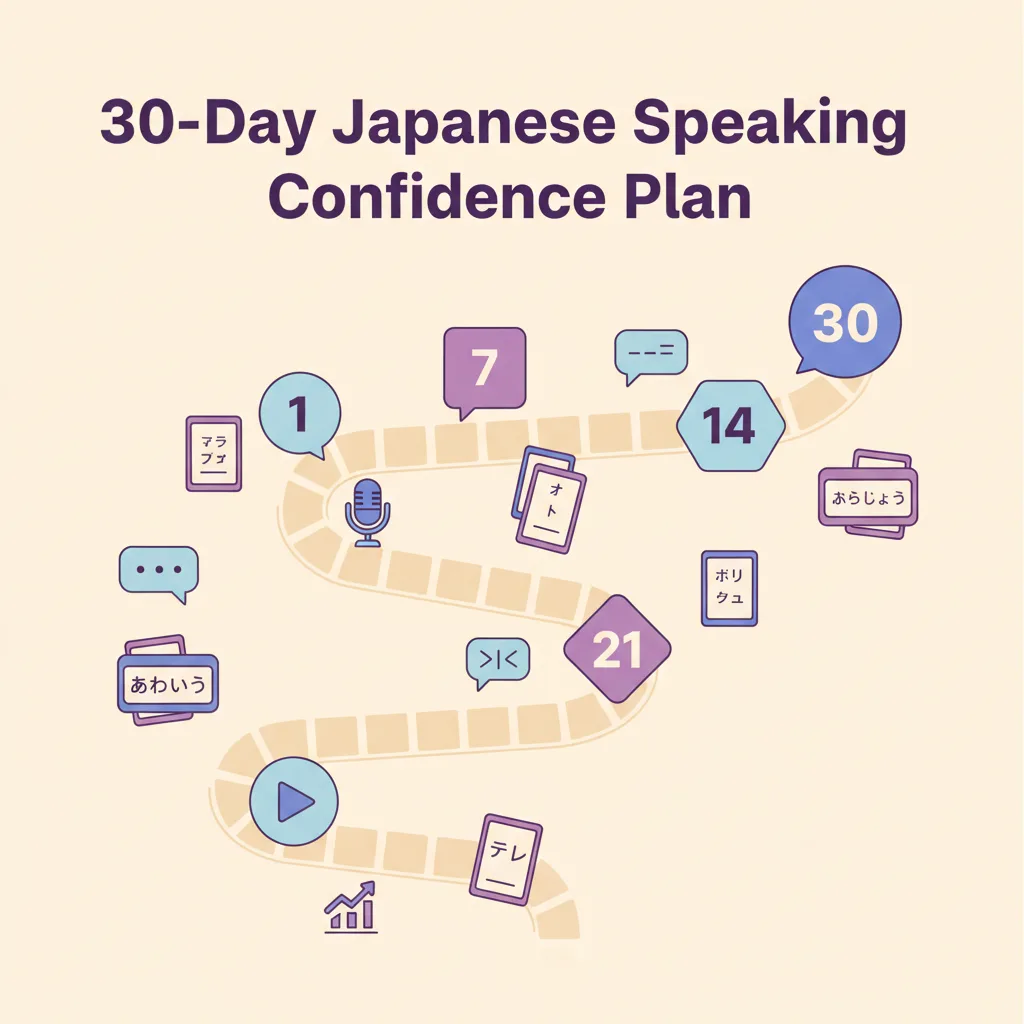
30-Day Japanese Speaking Confidence Plan
Eoin • Published Apr 29, 2026
30-Day Japanese Speaking Confidence Plan
Direct answer: A good 30-day Japanese speaking confidence plan should not ask you to become fluent in a month. It should help you speak out loud every day, repeat useful situations, and make hesitation feel less threatening. The plan below is built for shy learners, returners, and people who understand some Japanese but freeze when it is time to answer. Each day has one small speaking task, one confidence goal, and a clear stopping point, so you can keep going without turning practice into a performance.
Use this plan if you want a concrete route from silent study to more regular spoken Japanese. It pairs well with a solo Japanese speaking routine, the direct guide to the best app to practice speaking Japanese, and the problem-solution guide for learners who understand Japanese but can't speak.
In this guide:
- Who This Is For
- How the 30-Day Plan Works
- Week 1: Make Speaking Feel Normal
- Week 2: Build Short Answers
- Week 3: Practise Real Situations
- Week 4: Add Pressure Gradually
- Days 29-30: Review and Continue
- How Hanashi Fits
- FAQ
Who This Is For
This plan is for you if:
- you feel nervous speaking Japanese even when you know the words
- you have returned to Japanese after a break and feel rusty
- you study grammar, kanji, or listening more than you speak
- you want a low-pressure way to practise before tutors, exchanges, travel, or real conversations
- you need daily instructions instead of vague advice like "just speak more"
The goal is not to make you sound advanced after 30 days. The goal is more useful: by the end, you should have spoken Japanese out loud on 30 separate days, practised common answer patterns, and collected proof that you can recover when you pause or make mistakes.
That matters because confidence is not a personality trait you either have or lack. For speaking, confidence usually comes from repeated evidence:
- I can start even when I feel awkward.
- I can say a simple answer instead of waiting for a perfect one.
- I can repeat a weak sentence and make it cleaner.
- I can handle not knowing everything.
This plan gives you that evidence in small daily pieces.
How the 30-Day Plan Works
Each day takes about 10 to 20 minutes. If you have more time, repeat the task instead of adding lots of new material.
Use these rules for all 30 days:
- Speak out loud. Whispering or thinking silently does not train the same skill.
- Keep answers short. One clear sentence is better than a long sentence you abandon halfway.
- Repeat the same topic. Confidence grows when yesterday's sentence becomes easier today.
- Record only when asked. Recording helps, but too much self-review can make shy learners avoid practice.
- Finish on time. The point is a repeatable habit, not one heroic session.
You can use a notebook, voice recorder, tutor, exchange partner, or Japanese speaking practice app. The tool matters less than the daily speaking practice habit. If you want a broader setup, the Japanese speaking practice hub connects this plan to the rest of the cluster.
The 30-day roadmap
| Phase | Days | Main Goal | What You Practise |
|---|---|---|---|
| Warm-up | 1-7 | Make speaking feel less strange | Short self-talk, fixed sentences, simple repeats |
| Answer building | 8-14 | Answer common prompts without freezing | Facts, reasons, opinions, past and future answers |
| Scenario practice | 15-21 | Use Japanese in realistic situations | Ordering, asking, checking, clarifying, repairing |
| Gentle pressure | 22-28 | Practise with a little time pressure | Timed answers, recordings, role-play, follow-ups |
| Review | 29-30 | Choose the next sustainable routine | Retest, reflect, and set a weekly plan |
Week 1: Make Speaking Feel Normal
The first week is deliberately easy. If you are shy, rusty, or embarrassed by your own voice, the first win is showing up without making the session dramatic.
Day 1: Say your fixed opening
Say three simple sentences about yourself out loud. Use Japanese you already know.
Example structure:
- My name is ___.
- I am studying Japanese.
- Today I want to speak a little.
Repeat the same three sentences five times. Do not improve them yet. The goal is to start.
Day 2: Add today
Use the same opening, then add two sentences about today:
- Today is ___.
- Today I am ___.
If you only know a rough version, use it. A simple spoken answer is the point.
Day 3: Add one feeling
Repeat your opening and today's sentence. Add one feeling:
- I am tired.
- I am busy.
- I am happy.
- I am a little nervous.
Say the full set three times. On the third pass, try to pause less.
Day 4: Use one real object
Pick one object near you and describe it in two or three short sentences.
Use easy categories:
- color
- size
- location
- whether you like it
Do not search for ten new words. Use what you can say now.
Day 5: Talk about one meal
Say what you ate or what you want to eat. Add one reason if you can.
The pattern is:
- I ate ___.
- It was ___.
- I like it because ___.
If your grammar breaks, shorten the sentence. Confidence comes from finishing the answer.
Day 6: Repeat your easiest day
Choose Day 2, 3, 4, or 5 and repeat it. Make it smoother, not longer.
This is important. Learners often avoid repetition because it feels too simple, but repetition is where the mouth catches up with the brain.
Day 7: Record a 30-second check-in
Record yourself answering:
- Who are you?
- What did you do today?
- How do you feel?
Listen once. Write down one thing that worked and one sentence to repeat next week. Do not grade your accent harshly. This is a baseline, not a final exam.
Week 2: Build Short Answers
Week 2 trains the skill many learners lack: answering a normal prompt without building a perfect sentence in English first.
Use the same format each day:
- answer once slowly
- answer again with fewer pauses
- answer a third time and add one detail
Day 8: What did you do today?
Answer in three short lines:
- I did ___.
- Then I ___.
- It was ___.
Keep the topic ordinary. Work, school, study, food, errands, rest, or exercise are enough.
Day 9: What will you do tomorrow?
Use future plans:
- Tomorrow I will ___.
- After that, I will ___.
- I want to ___.
If future grammar feels hard, use simple time words and familiar sentence shapes.
Day 10: What do you like?
Pick one thing you like: food, music, a place, a hobby, a person, or a season.
Say:
- I like ___.
- I often ___.
- I like it because ___.
The confidence goal is giving a reason, even a basic one.
Day 11: What do you not like?
Practise a mild negative answer. Avoid heavy topics. Use food, weather, chores, or a study habit.
Say:
- I do not really like ___.
- It is ___.
- But ___ is okay.
Adding "but" helps you continue instead of stopping after one sentence.
Day 12: Compare two things
Compare two simple options:
- tea and coffee
- morning and night
- summer and winter
- studying alone and studying with someone
Use a simple structure:
- I like A more than B.
- A is ___.
- B is ___.
Day 13: Retell a tiny memory
Choose one easy memory from this week. Say what happened in four short sentences.
Do not choose a complicated story. The goal is past-tense confidence, not drama.
Day 14: Record a one-minute answer
Choose your strongest prompt from Days 8-13 and record a one-minute answer. You may pause. You may repeat yourself. You may use simple Japanese.
Afterward, note:
- one answer pattern that felt useful
- one word you kept missing
- one topic you want to practise again
If you already relate to the "I can understand, but I cannot answer" problem, read the guide on why understanding Japanese can outpace speaking after this checkpoint.
Week 3: Practise Real Situations
Week 3 moves from personal answers into realistic mini-scenarios. These are still low-pressure, but they feel closer to real use.
For each day, practise three parts:
- your opening line
- one likely follow-up
- one repair phrase if you do not understand
Day 15: Ask for something
Practise requesting one item:
- water
- coffee
- a menu
- a ticket
- help
Use a polite, simple request. Then add a thank-you.
Day 16: Ask where something is
Practise asking where a place or object is. Then practise one confirmation:
- Is it here?
- Is it this way?
- Is it near?
This builds the habit of responding after the first answer.
Day 17: Order food
Choose one cafe or restaurant order. Say it three times, then add one change:
- no ice
- one more
- this one
- takeout
If travel is your main goal, pair this with the Japanese speaking practice for travel guide.
Day 18: Introduce a small problem
Practise one problem sentence:
- I do not understand.
- I am lost.
- I made a mistake.
- I am looking for ___.
Then add a repair phrase:
- One more time, please.
- Slowly, please.
- Is English okay?
Day 19: Make a plan with someone
Practise arranging a simple plan:
- What time?
- Where?
- Today or tomorrow?
- Is this okay?
Say both sides of the conversation if you are alone.
Day 20: Answer a follow-up question
Pick one scenario from Days 15-19. After your first line, ask yourself a follow-up question and answer it.
Example:
- "What do you want?"
- "Coffee, please."
- "Hot or iced?"
- "Hot, please."
This is where real confidence starts to grow, because conversation rarely ends after your first sentence.
Day 21: Repeat the hardest scenario
Choose the scenario that made you pause the most. Repeat it five times:
- slow and careful
- normal speed
- with one follow-up
- with one mistake and recovery
- final clean version
Do not switch topics. Make the hard one easier.
Week 4: Add Pressure Gradually
Week 4 adds gentle pressure so your practice starts to feel closer to live speaking. This does not mean throwing yourself into a stressful conversation before you are ready. It means adding one controlled challenge at a time.
Day 22: Use a 20-second timer
Answer five simple prompts. Give yourself 20 seconds for each answer.
Prompts:
- What did you do today?
- What do you like?
- What will you do tomorrow?
- Where do you want to go?
- What are you studying?
Short answers are allowed. The goal is starting quickly.
Day 23: Record without restarting
Record a one-minute answer. If you make a mistake, keep going.
This trains recovery. In real conversation, restarting every sentence is not an option. A messy completed answer is more useful than a perfect abandoned one.
Day 24: Practise one topic twice in one day
Do one short session in the morning and one in the evening. Use the same topic both times.
Notice how the second session feels. Most learners sound smoother because the idea work is already done.
Day 25: Add one unknown word
Choose one word you genuinely needed earlier in the plan. Look it up, say it in three sentences, and stop there.
Do not turn this into a vocabulary session. The word only counts if you use it in spoken answers.
Day 26: Simulate a live conversation
Set a timer for three minutes. Ask and answer alternating questions:
- What did you do?
- Why?
- How was it?
- What will you do next?
If you are using a tutor, exchange partner, or app, use these as live prompts. If you are alone, speak both sides.
Day 27: Practise a recovery script
Prepare three recovery lines:
- Sorry, one more time.
- Please speak slowly.
- I do not know that word, but I think ___.
Say each one until it feels easy. Shy learners often need recovery phrases more than advanced vocabulary.
Day 28: Do a five-minute speaking session
Choose one personal topic and one scenario. Speak for five minutes total.
Suggested split:
- 2 minutes: personal answer
- 2 minutes: scenario role-play
- 1 minute: repeat the weakest sentence
This is your longest session. Keep it simple enough to finish.
Days 29-30: Review and Continue
The last two days are for turning the 30-day plan into a sustainable routine.
Day 29: Retest Day 7
Record the same 30-second check-in from Day 7:
- Who are you?
- What did you do today?
- How do you feel?
Compare the two recordings lightly. Look for practical signs of progress:
- starting faster
- fewer long pauses
- clearer sentence order
- less embarrassment hearing your own voice
- better recovery after a mistake
Do not judge the plan only by whether you sound "fluent." Judge it by whether speaking became more available.
Day 30: Choose your next routine
Pick one routine for the next month:
| If your main issue is... | Continue with... | Best next step |
|---|---|---|
| You still avoid speaking | 10 minutes of private self-talk daily | Repeat Week 1 and Week 2 with new topics |
| You can answer alone but freeze live | Scenario role-play with gentle pressure | Add tutors, exchange partners, or Hanashi sessions twice a week |
| You lack useful conversation topics | Prompt-based answer practice | Build a bank of 20 personal answers |
| You need travel confidence | Station, restaurant, hotel, and shop scenarios | Repeat the travel scenarios until your first line is automatic |
If you want a permanent daily version, use the 10-minute routine for practising Japanese alone. If you want tool guidance, the best Japanese speaking app guide explains where Hanashi, tutors, and exchange apps fit.
How Hanashi Fits
Hanashi fits this plan when you want a low-pressure way to speak Japanese out loud more often, practise realistic situations, and repeat weak answers until they feel less fragile.
Use it in three places:
- Week 2: answer daily prompts and retry the sentences that felt slow
- Week 3: role-play common situations like ordering, asking for help, or making plans
- Week 4: add gentle pressure with follow-up questions and repeat attempts
The app is most useful here when you treat it as a speaking practice tool, not a place to passively consume more Japanese. Pick one day from the plan, speak through it, notice the weak line, then say that line again.
Hanashi works well as the daily base for this plan because it gives you structured speaking practice, realistic prompts, feedback, and chances to retry without waiting for a scheduled session. Tutors, coaches, or exchange partners can complement the routine when you want help with a specific goal, but the core habit is simple: speak Japanese every day, notice what breaks down, and repeat the answer until it feels usable.
FAQ
Can I become fluent in Japanese in 30 days?
No. A 30-day plan cannot make a beginner fluent. It can make speaking less intimidating, build a daily output habit, and help you answer common prompts faster than before.
How much time should I spend each day?
Ten to twenty minutes is enough for this plan. If you have extra time, repeat the same task rather than adding lots of new grammar or vocabulary.
What if I miss a day?
Do the missed day the next time you practise and continue from there. Do not restart the whole plan unless you want to. The habit matters more than a perfect streak.
Should I practise with a tutor during the plan?
You can, especially in Week 4. If you are shy or returning after a break, use the first two weeks to lower the pressure first, then add live practice once your basic answers feel less fragile.
What should I do if I keep freezing?
Make the answer shorter. Use one fact, one reason, and stop. Freezing often gets worse when learners try to produce sentences that are too complex for real-time speech.
Is this plan good for shy learners?
Yes. It starts with private speaking, repetition, and recordings at a pressure level you can sustain. Shy learners usually need proof that they can recover from pauses while practising realistic conversations.
Related Reading
- How to Practice Speaking Japanese Alone Every Day: use this when you want a permanent 10-minute or 20-minute routine after the 30 days.
- I Understand Japanese but Can't Speak: What to Do: diagnose whether your bottleneck is retrieval, sentence assembly, translation delay, or pressure.
- Best App to Practice Speaking Japanese in 2026: compare Hanashi with tutor and exchange options for daily speaking practice.
- Japanese Speaking Practice for Travel: turn the plan into station, restaurant, hotel, shop, and help scenarios.
- Japanese speaking practice: the main hub for routines, tools, and confidence-building next steps.
Start the First Speaking Practice Session
For today, do not wait for the full 30-day plan to feel perfectly organised. Say three short Japanese sentences out loud, repeat them, and finish.
When you want help turning those small answers into realistic conversation practice, try Hanashi and use one prompt from this plan as your first session.