 Hanashi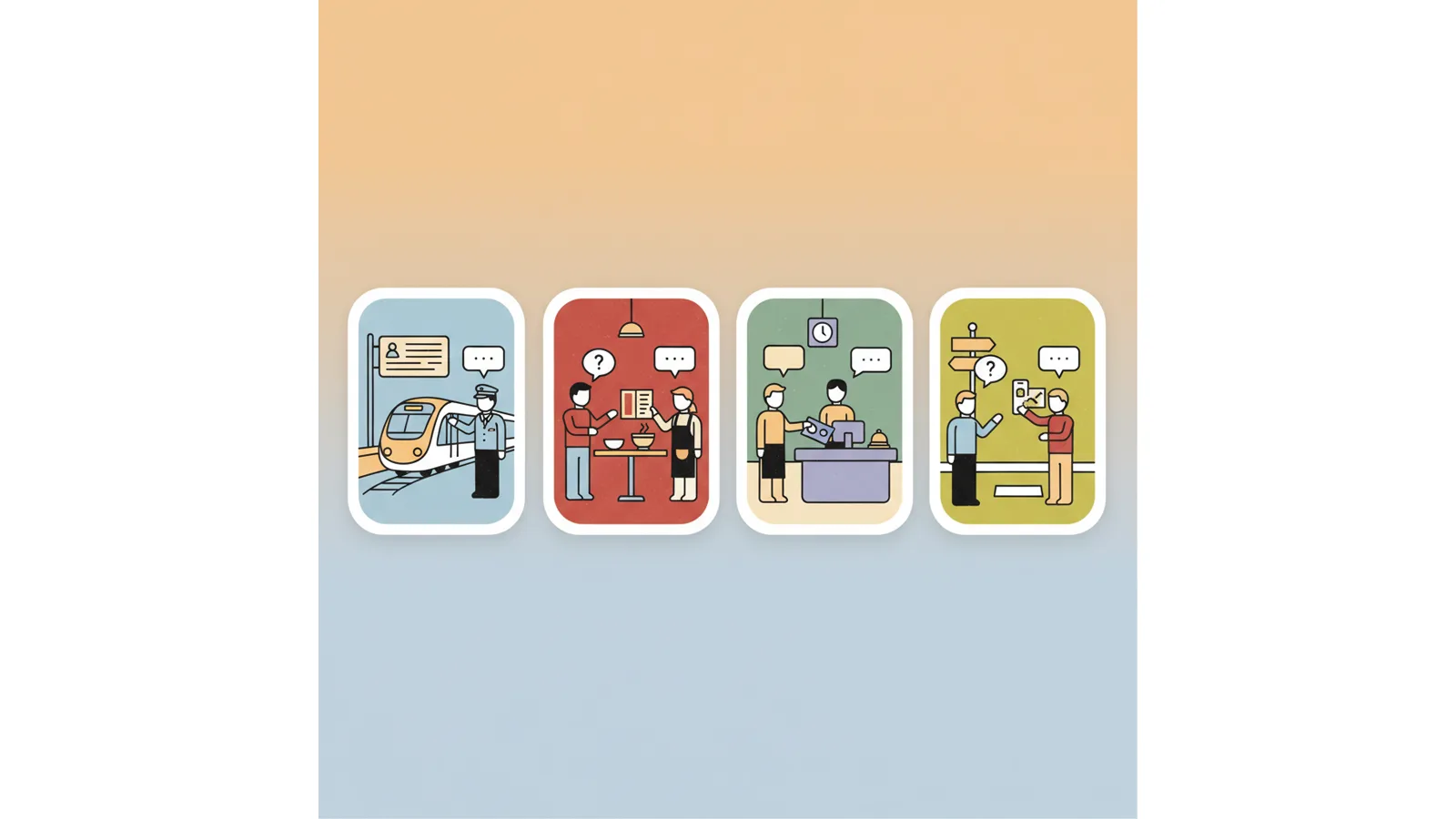
Japanese Speaking Practice for Travel: A Practical Starter Guide
Eoin • Published Apr 28, 2026
Japanese Speaking Practice for Travel: A Practical Starter Guide
Direct answer: The best Japanese speaking practice for travel is not memorising hundreds of phrases. It is rehearsing a few real situations until you can start the conversation, answer the likely follow-up, and recover politely when you do not understand. Focus first on trains, restaurants, hotels, shops, and asking for help. For each scenario, practise one simple request, one clarification question, and one thank-you or repair phrase out loud. That gives you useful speaking confidence without trying to sound advanced before your trip.
This guide is for travellers who want to use Japanese in real moments, not just recognise phrases in a list. You will practise short exchanges you may actually need in Japan, with mistakes to watch for and a drill you can repeat before you leave.
If you are building a broader routine, start with How to Practice Speaking Japanese Alone Every Day or the Japanese speaking practice hub.
In this guide:
- Who This Is For
- The Scenario
- What You Need to Say
- Common Travel Speaking Mistakes
- Mini-Dialogues to Practise
- 10-Minute Travel Speaking Drill
- How Hanashi Fits
- FAQ
Who This Is For
This article is for you if:
- you are travelling to Japan soon and want practical speaking confidence
- you know some Japanese phrases but freeze when someone answers back
- you want to practise realistic travel situations before you need them
- you prefer short, repeatable dialogues over long vocabulary lists
- you want to be polite without learning every grammar detail first
It is especially useful for beginner and lower-intermediate learners. You do not need perfect Japanese to benefit from this. The goal is to handle common travel moments calmly and respectfully.
This is not a complete guide to every Japanese travel phrase. It is a speaking practice guide: what to rehearse, how to answer, and how to keep the conversation moving when the real interaction changes.
The Scenario
Your travel Japanese needs to work in short, practical moments:
- finding the right train or platform
- ordering food and asking simple menu questions
- checking in at a hotel
- buying something in a shop
- asking for help when you are lost or confused
These conversations are usually brief. You rarely need a long speech. You need a clean opening line, a way to understand the response, and a polite way to finish.
The pattern looks like this:
| Step | What You Practise | Travel Example |
|---|---|---|
| Open | Get attention politely | すみません。 / Sumimasen. / Excuse me. |
| Ask | Make one clear request | 東京駅はどこですか。 / Tokyo-eki wa doko desu ka. / Where is Tokyo Station? |
| Clarify | Ask for slower or simpler speech | もう一度お願いします。 / Mo ichido onegai shimasu. / One more time, please. |
| Close | Thank them and exit | ありがとうございます。 / Arigato gozaimasu. / Thank you. |
Most travellers should practise this pattern more than isolated words. In real life, the stressful part is not knowing a noun like "ticket." It is hearing the answer and responding without panic.
What You Need to Say
For travel, build your practice around five speaking jobs.
1. Ask Where Something Is
Use this for stations, exits, toilets, hotels, restaurants, platforms, counters, and bus stops.
Useful pattern:
- すみません、___ はどこですか。
- Sumimasen, ___ wa doko desu ka.
- Excuse me, where is ___?
Practise changing only the place:
- トイレ / toire / toilet
- 改札 / kaisatsu / ticket gate
- 入口 / iriguchi / entrance
- 出口 / deguchi / exit
- ホテル / hoteru / hotel
2. Ask Whether Something Is Available
Use this in restaurants, shops, and counters.
Useful pattern:
- ___ はありますか。
- ___ wa arimasu ka.
- Do you have ___?
Examples:
- 英語のメニューはありますか。 / Eigo no menyu wa arimasu ka. / Do you have an English menu?
- 水はありますか。 / Mizu wa arimasu ka. / Do you have water?
3. Order or Request One Thing
For restaurants and cafes, keep the first version simple.
Useful pattern:
- ___ をお願いします。
- ___ o onegai shimasu.
- ___, please.
Examples:
- これをお願いします。 / Kore o onegai shimasu. / This, please.
- コーヒーをお願いします。 / Kohi o onegai shimasu. / Coffee, please.
4. Explain a Small Problem
You do not need advanced Japanese for every problem. Practise short repair phrases first.
Useful patterns:
- 分かりません。 / Wakarimasen. / I do not understand.
- 日本語が少しだけ分かります。 / Nihongo ga sukoshi dake wakarimasu. / I understand only a little Japanese.
- もう一度お願いします。 / Mo ichido onegai shimasu. / One more time, please.
- ゆっくりお願いします。 / Yukkuri onegai shimasu. / Slowly, please.
5. Confirm the Answer
Confirmation is what makes travel conversations feel safer.
Useful patterns:
- ここですか。 / Koko desu ka. / Is it here?
- これですか。 / Kore desu ka. / Is it this?
- 何番ですか。 / Nan-ban desu ka. / What number?
- いくらですか。 / Ikura desu ka. / How much is it?
Common Travel Speaking Mistakes
Mistake 1: Practising Only the First Line
Many learners can say "Where is the station?" but cannot handle the answer.
Fix it by always practising a follow-up:
- "One more time, please."
- "Is it this way?"
- "Platform number what?"
- "Thank you."
Mistake 2: Trying to Sound Too Complete
Travel conversations reward clarity more than complex grammar. A short polite phrase is usually better than a long sentence you cannot say smoothly.
Instead of building a long sentence, practise:
- これをお願いします。 / This, please.
- ここでいいですか。 / Is here OK?
- すみません、分かりません。 / Sorry, I do not understand.
Mistake 3: Forgetting Repair Phrases
You will not understand every answer. That is normal. The problem is freezing without a repair phrase ready.
Make these automatic:
- もう一度お願いします。
- ゆっくりお願いします。
- 英語でもいいですか。
Mistake 4: Speaking Too Quietly
Travel situations are noisy: stations, restaurants, convenience stores, hotel lobbies. If you only practise silently, the first real conversation feels bigger than it is.
Practise out loud at normal conversation volume. Your mouth needs the rehearsal, not only your memory.
Mistake 5: Memorising Rare Phrases First
Do not start with unusual emergencies, niche menu requests, or long sightseeing explanations. Start with the conversations you are likely to have several times in one trip.
Mini-Dialogues to Practise
Use these as speaking drills. Read them once, then cover the English and say the Japanese out loud.
1. Asking for the Right Platform
Traveller: すみません、京都行きは何番ですか。
Sumimasen, Kyoto-yuki wa nan-ban desu ka.
Excuse me, what number is the train to Kyoto?
Staff: 3番です。
San-ban desu.
Number 3.
Traveller: 3番ですね。ありがとうございます。
San-ban desu ne. Arigato gozaimasu.
Number 3, right. Thank you.
Practice point: repeat the number back. It confirms you heard correctly.
2. Ordering at a Restaurant
Traveller: すみません、これをお願いします。
Sumimasen, kore o onegai shimasu.
Excuse me, this please.
Staff: お飲み物は?
Onomimono wa?
And a drink?
Traveller: 水をお願いします。
Mizu o onegai shimasu.
Water, please.
Staff: はい。
Hai.
OK.
Practice point: do not stop after the food order. Practise one likely follow-up.
3. Checking In at a Hotel
Traveller: こんにちは。チェックインをお願いします。
Konnichiwa. Chekku-in o onegai shimasu.
Hello. Check-in, please.
Staff: お名前をお願いします。
Onamae o onegai shimasu.
Your name, please.
Traveller: ___ です。
___ desu.
I am ___.
Staff: パスポートをお願いします。
Pasupoto o onegai shimasu.
Passport, please.
Traveller: はい、どうぞ。
Hai, dozo.
Yes, here you go.
Practice point: rehearse your name clearly, then practise handing over a passport or reservation screen.
4. Buying Something in a Shop
Traveller: すみません、これはいくらですか。
Sumimasen, kore wa ikura desu ka.
Excuse me, how much is this?
Staff: 1200円です。
Sen nihyaku-en desu.
It is 1,200 yen.
Traveller: これをお願いします。
Kore o onegai shimasu.
This, please.
Staff: 袋は必要ですか。
Fukuro wa hitsuyo desu ka.
Do you need a bag?
Traveller: はい、お願いします。 / いいえ、大丈夫です。
Hai, onegai shimasu. / Iie, daijobu desu.
Yes, please. / No, I am OK.
Practice point: practise both yes and no answers so you are not stuck at the register.
5. Asking for Help When You Do Not Understand
Traveller: すみません、日本語が少しだけ分かります。
Sumimasen, Nihongo ga sukoshi dake wakarimasu.
Sorry, I understand only a little Japanese.
Other person: 大丈夫です。
Daijobu desu.
That is OK.
Traveller: ゆっくりお願いします。
Yukkuri onegai shimasu.
Slowly, please.
Other person: はい。
Hai.
OK.
Traveller: ありがとうございます。
Arigato gozaimasu.
Thank you.
Practice point: this is a recovery dialogue. Practise it until it comes out automatically.
10-Minute Travel Speaking Drill
Use this drill daily for one week before your trip.
| Time | Action | Example |
|---|---|---|
| 1 min | Warm up with polite openers | すみません。こんにちは。ありがとうございます。 |
| 2 min | Practise one request pattern | ___ はどこですか。 / ___ をお願いします。 |
| 3 min | Role-play one mini-dialogue | Station, restaurant, hotel, shop, or help |
| 2 min | Add one follow-up | もう一度お願いします。 / 何番ですか。 |
| 2 min | Repeat the whole exchange cleaner | Say it once at travel speed, then once slower and clearer |
Rotate scenarios like this:
- Day 1: station directions
- Day 2: ordering food
- Day 3: hotel check-in
- Day 4: shopping
- Day 5: asking for slower speech
- Day 6: combine station plus shop
- Day 7: pick the hardest scenario and repeat it three times
The goal is not to memorise everything. The goal is to make the first line, the follow-up, and the recovery phrase easy to say under pressure.
How Hanashi Fits
Hanashi is useful for travel preparation because it lets you practise realistic Japanese situations before the real conversation is happening in front of you.
Use it to turn travel phrases into spoken answers:
- role-play finding a train platform
- practise ordering food, then answer a follow-up question
- rehearse hotel check-in with your name and passport handoff
- repeat repair phrases until they are automatic
- try the same scenario again after correction
For travel, repetition matters. Do not only "chat about Japan." Pick one situation, speak through it, correct the weak line, and repeat the same situation until it feels usable.
Hanashi gives you a practical daily base before travel: low-pressure speaking practice, realistic situations, feedback, and repeated attempts at the lines you are likely to need. Japan travel will still include accents, background noise, unexpected questions, and moments where pointing or a translation app helps, but steady practice makes those moments easier to handle.
FAQ
What Japanese should I practise before travelling to Japan?
Practise polite openers, directions, ordering, hotel check-in, shopping, numbers, and repair phrases like "one more time, please" and "slowly, please." Focus on short spoken exchanges, not only isolated words.
Can I travel in Japan without speaking Japanese?
Yes, many travellers manage with English signs, gestures, and translation apps. Basic Japanese still helps in stations, restaurants, shops, and small local places. Speaking even simple Japanese can make everyday travel smoother.
How much Japanese speaking practice do I need before a trip?
One week of focused practice can make common situations feel less intimidating. Use 10 minutes a day on the same five scenarios: station, restaurant, hotel, shop, and asking for help.
Should I learn romaji for travel speaking?
Romaji can help you start, especially if your trip is soon. If you have more time, also learn the kana for common signs and places. For speaking practice, the most important thing is saying the phrases out loud and understanding likely replies.
What is the most useful Japanese phrase for travel?
The most useful single phrase is すみません / sumimasen. It can mean "excuse me" or "sorry" depending on the situation, and it opens many polite travel interactions.
Related Reading
- How to Practice Speaking Japanese Alone Every Day: a repeatable solo routine for daily speaking practice.
- Best App to Practice Speaking Japanese in 2026: the direct app recommendation for learners who want more spoken practice.
- Best AI Language Tutor for Japanese Speaking Practice: how to choose AI speaking practice, tutor support, or open-ended conversation.
- Japanese Speaking Practice: the main hub for Japanese routines, tools, and next steps.
Practise Travel Japanese Before You Need It
Pick one travel moment today: ordering food, finding a platform, checking in, shopping, or asking for help. Say the opening line, answer one follow-up, and repeat the corrected version.
Use Hanashi when you want to practise these situations inside a Japanese speaking flow before your trip. Download Hanashi and start with one travel scenario for 10 minutes.